

Table of Contents
- Step 1: Recognise the Signs of Performance Anxiety in Athletes
- Step 2: Pre-Game Anxiety Tips for the Hours Before Competition
- Step 3: Breathing Exercises for Athletes to Calm the Stress Response
- Step 4: Visualisation Techniques for Sport and Positive Self-Talk
- Step 5: How to Overcome Sports Anxiety Through Preparation and Goals
- Step 6: Track Progress and Adapt Techniques to Your Sport and Age
- Step 7: When to Seek Professional Support for Treating Performance Anxiety in Athletes
- Frequently Asked Questions
Last Updated: October 13, 2026
Step 1: Recognise the Signs of Performance Anxiety in Athletes
Performance anxiety is the fear of failing or being judged in a competitive setting, and it shows up in the body long before the mind admits it. It affects athletes at every level, from weekend club players to elite competitors. This guide walks through a plan for treating performance anxiety in athletes, using tools you can start today.
The signs are easy to miss because they look like nerves. Sweaty palms, a racing heart, a churning stomach. Those are normal. The problem starts when they hijack your game.
Physical, Emotional and Behavioural Symptoms
Physical signs include a fast heartbeat, tight chest, shaking hands, nausea, and tense muscles. Emotional signs include dread, irritability, and a fear of letting people down. Behavioural signs are the ones others notice: avoiding certain events, over-practising, or going quiet before a match.
A common mistake is treating one bad game as proof of a deeper problem. It usually isn’t. Look for patterns across weeks, not one rough afternoon.
Normal Nerves vs. a Problem That Needs Support
Normal nerves fade once you start moving. They sharpen focus and lift effort. A problem that needs support does the opposite. It grows, it lingers, and it costs you sleep, appetite, or enjoyment of the sport you once loved.
Ask three questions:
- Do the symptoms show up most days, not just on game day?
- Are you avoiding training or competition?
- Has your performance dropped for more than a few weeks?
If you answer yes to two or more, that is a signal to seek support, not to push harder.
Step 2: Pre-Game Anxiety Tips for the Hours Before Competition
The hours before a game decide how much fuel anxiety gets. Structure beats willpower here. When the plan is fixed, the mind has less room to spiral.
Build a Consistent Pre-Competition Routine
A routine works because it is boring. Same meal, same warm-up, same music, same arrival time. The body learns the sequence and settles into it.
What most guides miss is timing. Start your routine the night before, not two hours out. Lay out gear, check travel, and set a firm lights-out time. A tired athlete feels anxious faster.
On the day:
- Eat a familiar meal two to three hours before
- Arrive early enough to settle, not so early you sit and stew
- Do a light warm-up with stretching to release physical tension
- Use the same cue words each time
Write your routine down and keep it in your kit bag. On high-pressure days, you follow the page instead of your racing thoughts.
Step 3: Breathing Exercises for Athletes to Calm the Stress Response
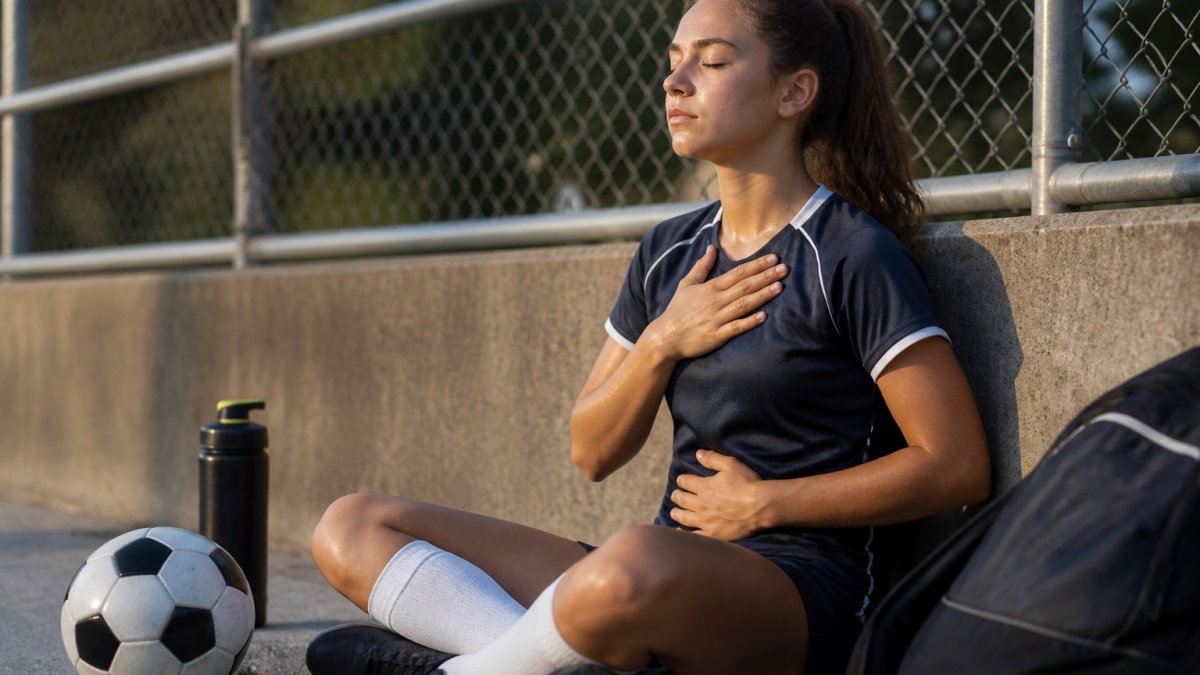
Breathing exercises for athletes work because they speak directly to the stress response. Slow, deep breathing with a longer exhale increases parasympathetic activity, the branch of the nervous system that lowers heart rate, reduces muscle tension, and steadies attention. That is the mechanism, and it is why breathing is the fastest portable tool an athlete has.
Match the Pattern to the Moment
Most guides give one pattern and stop. In practice, the right pattern depends on whether you are over-aroused (too revved up) or under-aroused (flat and sluggish).
If you are over-aroused, racing heart, tight chest, shallow breath, use a longer exhale:
- Breathe in through the nose for a count of four
- Hold gently for four
- Breathe out through the mouth for six to eight
- Repeat for two minutes
The longer exhale is the active ingredient. It signals safety to the body and pulls arousal down.
If you are under-aroused, heavy legs, low energy, difficulty switching on, use a shorter, sharper pattern:
- Breathe in through the nose for a count of four
- Breathe out through the mouth for a count of four
- Repeat for 60 to 90 seconds, sitting or standing tall
This keeps you alert without tipping into panic. Getting the direction wrong is one of the most common reasons athletes say “breathing doesn’t work for me.”
Practise It Before You Need It
A breathing pattern only becomes automatic with repetition. Aim for two minutes daily, plus a short version before every training session. By competition day, the pattern should feel like a habit rather than a decision.
Pair the breathing with a physical anchor, hand on the chest, feet flat on the ground, or a specific spot on the sideline. The anchor becomes a trigger, so the calm arrives faster each time.
When Breathing Alone Is Not Enough
Breathing lowers arousal, but it does not change the thoughts feeding it. If your heart rate settles and the worry stays, that is a signal to add the reframing and visualisation work in Step 4. Breathing is the first tool, not the only one.
A common pattern is for athletes to breathe well in training and abandon the technique under real pressure. That is not failure, it is a sign the pattern needs more rehearsal in progressively harder conditions. The Australian Institute of Sport resources on athlete wellbeing outline similar recovery and readiness principles for competitors, and most sport psychologists treat breathing as a foundation skill rather than a standalone cure.
A Note on Evidence
Slow breathing with an extended exhale has reasonable support for reducing pre-competition arousal, and it is low-risk and free. What it does not do is resolve persistent anxiety that shows up most days, affects sleep, or drives avoidance. For that pattern, see Step 7.
Step 4: Visualisation Techniques for Sport and Positive Self-Talk
Visualisation techniques for sport train the brain before the body performs. You rehearse the skill, the crowd, and the pressure in your mind, so the real thing feels familiar rather than threatening.
Spend five minutes before sleep picturing your event in detail. See the venue, hear the noise, feel your feet on the ground. Then run the sequence you want, not the one you fear.
Cue Words and Thought Reframing
Cue words are short phrases you repeat to direct attention. “Smooth,” “breathe,” “next ball.” They crowd out negative thoughts by giving the mind a job.
Thought reframing means swapping a harsh thought for a fair one. “I always choke” becomes “I’ve handled pressure before.” You are not lying to yourself. You are correcting a distortion.
Trying to block negative thoughts entirely backfires. The harder you push them down, the louder they get. Replace them instead of fighting them.
Step 5: How to Overcome Sports Anxiety Through Preparation and Goals
You overcome sports anxiety by shrinking the gap between what you expect and what you can control. Preparation does that. So does goal setting that fits reality.
Set two kinds of goals. Outcome goals are the result you want. Process goals are the actions you own: first-serve percentage, tackle count, split times. Process goals keep attention on effort when the scoreboard is out of reach.
Make goals achievable and meaningful. A goal you cannot influence only feeds pressure. A goal you can tick off builds confidence, and confidence is the quiet antidote to anxiety.
Step 6: Track Progress and Adapt Techniques to Your Sport and Age
Progress is invisible unless you record it. A simple log turns a vague feeling into evidence you can act on.
| What to Track | How to Record It | Why It Helps |
|---|---|---|
| Anxiety level | Rate 1-10 before each session | Shows whether techniques are working |
| Sleep and rest | Hours per night | Links fatigue to nerves |
| Technique used | Breathing, cue words, visualisation | Reveals what suits you best |
| Performance note | One line after each event | Tracks trends over weeks |
Adapt to your sport and age. A teenage gymnast needs shorter routines than a masters rower. Younger athletes benefit from parent and coach support, not pressure. Older athletes often need more recovery time, which itself lowers anxiety.
Track for four weeks before judging a technique. Anxiety shifts slowly, and early data often looks worse before it looks better.
Step 7: When to Seek Professional Support for Treating Performance Anxiety in Athletes
Some anxiety needs more than self-help. If nerves are affecting your sleep, mood, or daily life, or if you have stopped competing altogether, it is time to bring in a professional.
Start with your GP, who can rule out physical causes and point you to the right support. A sport psychologist can teach structured mental skills. For anxiety that has resisted years of talk therapy, Rapid Transformational Hypnotherapy offers a different route. Susan Hayden works with the subconscious patterns that keep anxiety repeating, rather than only managing symptoms.
RTT is not a replacement for medical care. It is a focused approach for breaking the loops that keep fear and self-sabotage in place. Many clients find it helpful when willpower alone has not worked.
For athletes struggling with persistent nerves, burnout, or perfectionism, our RESET Package and FREE Consultation are a practical starting point.
Anxiety does not have to end your sporting life. With the right routine, breathing, and support, most athletes regain their focus and their enjoyment of the game. Susan Hayden is a Clinical Hypnotherapist and RTT practitioner in Bokarina who helps athletes and high performers break the cycles of anxiety, perfectionism, and self-sabotage. Through Rapid Transformational Hypnotherapy, she addresses the root cause, not just the symptoms, so confidence and calm last. Book a session with Susan Hayden and take the first step back to the sport you love.
Frequently Asked Questions
How can athletes manage performance anxiety during competition?
Athletes can manage performance anxiety in the moment using slow breathing exercises, cue words and present-moment focus. A pre-competition routine that includes physical warm-up and mental preparation helps regulate the stress response before it peaks. During competition, shifting attention to controllable actions (footwork, breathing, technique) rather than outcomes reduces pressure. Regular practice of mindfulness and visualisation techniques for sport builds the mental skills needed to stay calm under competitive pressure.
Can breathing exercises help with sports performance anxiety?
Yes. Slow, controlled breathing activates the body’s relaxation response, lowering heart rate and reducing physical symptoms of anxiety such as muscle tension and shallow breathing. Simple techniques like box breathing or 4-7-8 breathing can be done in under two minutes and fit easily into a pre-game routine. Practising daily, not just on competition day, builds body awareness and makes the technique more effective when pressure is highest.
When should an athlete seek professional help for performance anxiety?
An athlete should seek professional support when anxiety consistently interferes with training, competition or daily life, when it causes avoidance of sport, or when self-help techniques are not providing relief. Persistent physical symptoms, sleep disruption or low mood are also signs that additional support may help. A qualified professional can assess whether the anxiety needs clinical treatment and recommend an appropriate approach.
What are the signs of sports performance anxiety?
Signs include physical symptoms such as racing heart, sweating, nausea, trembling and muscle tension before or during competition. Emotional signs include excessive worry, fear of failure, irritability and a sense of dread. Behavioural signs may include avoidance, reduced concentration, perfectionism, making uncharacteristic mistakes or withdrawing from teammates. Recognising these early helps athletes apply coping strategies before anxiety escalates and affects sport performance.